NLCS Game Three: “Be really stubborn in there”

Jackson Chourio

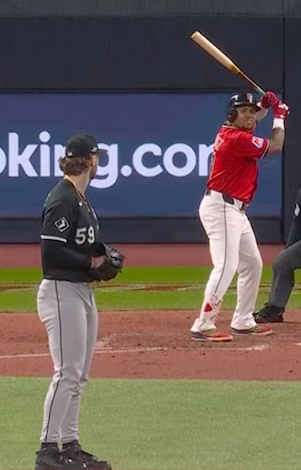
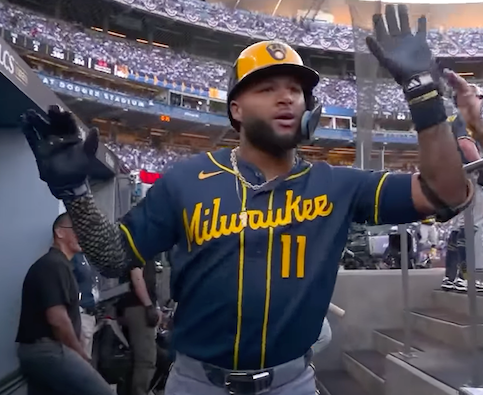
Chourio accepts his props for hitting Game Three’s first pitch into the bleachers Thursday night.

After his Dodgers lost National League Championship Series Game One by a measly 2-1 score, Mookie Betts said they needed to start playing Dodger baseball, “whatever Dodger baseball is.” Then, they lost Game Two a little more decisively, 7-4.

Now, you might not really want to know what they’re thinking. Not after the Brewers knocked them into the NLCS hole 0-3, with Wednesday night’s quite emphatic 6-2 Game Three win.

The Damndodgers are on the brink of winter vacation without a World Series berth to show for being 2026 baseball’s . . . second-winningest team. For being even-up with the Brewers prior to this NLCS, going 8-2 in their last regular season ten and going 15-5 in their last regular season twenty and going 20-10 in their last regular season thirty.

Oops. The Brewers went 22-8 in their last regular season thirty. They also went 4-3 against the Dodgers in their regular season series against each other. The Brewers team OPS was .743 to the Dodgers’s .762, a -19 point difference. Their team fielding-independent pitching (fourth in Show this year) showed the Dodgers (second in Show) only four points lower.

In other words, there wasn’t that much reason to assume the Damndodgers—those money-throwing monstrosities who can’t possibly have anything else such as scouting, player development, analytics, brains, and guts to make them NL West champions thirteen of the last fourteen seasons—were that far superior to these saintly scrappers out of the Milwaukee bargain houses.

Well, now. The Family Dollars are on the threshold of going to the Big Dance. All they have to do is take one more from the Cartiers. Difficult, but not impossible.

If the Dodgers find a way to batter the Brewers in Game Four Thursday night, the Brewers could always elect to make sacrificial lambs of relievers they haven’t yet deployed, comfortable knowing they have Jacob Misiorowski to ride in Game Five. Les Mis, plus their usual case of off-off-off-off-Broadway anti-stars. Even if it’s a Misiorowski-Tarik Skubal rematch.

Misiorowski to one side, how many people outside the burg that made beer ubiquitous could name one of the Brewers’s current cadre of characters not named Les Mis, Christian Yelich, Jackson Chourio, or William (Kid Brother of Willson) Contreras, before this postseason began?

Chourio merely renewed his name recognition Thursday night. All the left fielder had to do was exactly what he did in Dodger Stadium, hit Game Three’s first pitch the other way and over the right center field fence.* With one swing, he renewed his prospects of becoming the second Jackson behind a certain Hall of Famer to be thought of as any type of Mr. October.

“I was still putting my batting gloves on to get ready,” said Brewers first baseman Jake Bauers, who batted fifth in the lineup Thursday. “I just saw the ball flying, and I knew he got it. It kind of set the tone for the day and let everyone know that we’re here to win this game.”

There’d be two more bombs to come later in the game, from two of the Brewers’s heretofore-unknown soldier contingency. From Bauers, hitting a two-run homer in the seventh, then from center fielder Garrett Mitchell, following almost immediately with a solo blast landing not far from Bauers’s bomb.

So where did this power originate? Isn’t that anything but the Brewers’s usual game of scrape, fleck, hunt, and peck?
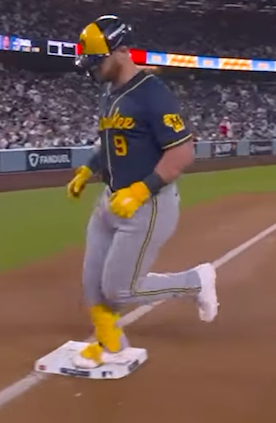
Jake Bauers

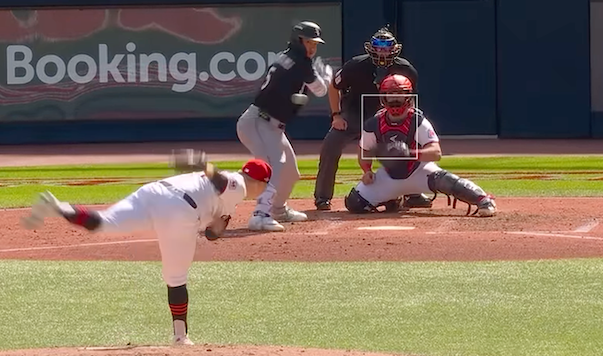
Bauers rounding third off his eleventh-pitch two-run homer.

“It’s funny,,” said outfielder Sal Frelick postgame. “We are hitting some homers, but that’s not the approach at the plate. It’s just: apply pressure, apply pressure. I think by applying pressure, we’re able to dictate that pace of play. It’s not result-oriented, it’s just at-bat oriented. It doesn’t matter if you get out, get on, strike out, whatever. Just take a chunk of the pitcher with you and establish playing that way.”

They’d take their chunks out of Dodgers starting pitcher Blake Snell in due course. First, they had to navigate the lefthander shutting them out for five innings to follow Chourio’s rude introduction. Other than a one-out walk (Mitchell) and base hit to left (rookie shortstop Cooper Pratt) in the second, Snell looked as though he’d filed ownership papers on the guys too many still underrate.

Brewers starter Robert Gasser (now, there’s a name for a pitcher, even if his fastball isn’t the type to be called a gasser) was almost as good as Snell before turning it over to the bullpen. He pitched five solid and survived the Dodgers putting their leadoff men aboard three times and coming up scoreless.

At first, it looked as though manager Pat Murphy played the wrong hand. Abner Uribe, heretofore one of the Brewers’s more effective relievers, had his first truly shaky postseason outing in the sixth: walk (left fielder Teoscar Hernández), walk (right fielder Kyle Tucker), swinging strikeout (pinch hitter Max Muncy), walk (still-ailing designated hitter Shohei Ohtani), two-run double (catcher Will Smith). Forcing Murphy to reach for DL Hall to keep the deficit to 1-2.

Come the top of the seventh, though, the Brewers made Dodgers manager Dave Roberts pay for forgetting Snell’s career-long vulnerability: going the third time around the enemy lineup. Already leaving himself vulnerable by switching parts of his better defense out of the game, Roberts’s forgetfulness may yet prove a key reason why the Dodgers don’t three-peat, if they don’t.

Snell walked DH Andrew Vaughn after a seven pitch battle to open. With Christian Yelich pinch running, the lefthander fought the portside-swinging Bauers epically, through ten pitches. On the full-count eleventh pitch, Yelich took off as though a police cruiser bore  down upon him . . . and Bauers hit the pitch into the right field bleachers.

That overthrew the not-quite-secure Dodger lead by a run. Mitchell checked in, took ball one, then drove one not far from where Bauers’s blast landed. Ending Snell’s evening two batters too late, leaving Evan Phillips to come in and get three outs to contain the damage.

Unfortunately for the Dodgers, that containment lasted only long enough for Roki Sasaki to surrender back-to-back one-out eighth-inning singles to second baseman Brice Turang and catcher Contreras. Roberts brought Justin Wrobleski in for Yelich. Wrobleski put Yelich in the hole 0-2 before throwing a ball off the plate and Smith’s mitt, enabling Turang to score.

It almost felt as though the Brewers rubbed it in a little in the ninth. Pratt singled with one out, stole second with two out and third baseman Joey Ortiz at the plate, then came home with the sixth and final run when Ortiz punched a bast hit. Walk the line? They’ll walk, single, punch, slash, grind, and bomb the line. Whatever it takes.

“Murph says it, Murph preaches it, Murph expects it. Ball-strike them, get good pitches to hit,” said Vaughn post-game. “If [the pitcher’s] not going to give you anything, walk to first base. Be really stubborn in there, and that’s going to help us win ballgames.”

“Not swinging at crap” is the way Pratt put it. Roberts isn’t that blunt, but he all but agreed with the freshman shortstop.

“They’re taking better at-bats than they did last year,” said Roberts, recalling the Dodgers’s sweeping the Brewers in last year’s NLCS. “Their ball-in-play averages, gosh dang, it’s got to be .400. When they put the ball in play, it’s a hit. They’re also slugging, which they didn’t do last year. Those are good combos.”

Good, stubborn combos. The kind that win postseason games. Postseason series, even.

* As analyst Jessica Brand pointed out, it’s the first game-opening, first-pitch, first-batter bomb in Brewers history. Chourio hit a first-pitch, first-inning homer in NLCS Game Two last year, but it was the bottom of the first.
 

NLCS Game One: A Damndodger hole

Brice Turang, Tarik Skubal

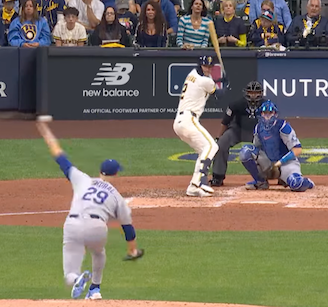
Brice Turang about to send Tarik Skubal’s unsinking sinker into the bullpen Sunday night . . .

When the National League Championship Series opened Sunday night, guess what didn’t happen? The big spending blue whale didn’t devour the anchovies hosting them in the somewhat foggy Milwaukee pond. American Family Field hoisted baseball’s best (the home team) and second-best (the visitors) records this season.

The visiting Damndodgers and the hosting Brewers even got to throw their best pitchers at each other. How often do you get a defending Cy Young Award winner against the guy likely to win one this time around? Forget that a moment. This was going to be shades of Sandy Koufax v. Whitey Ford. Wasn’t it?

Not quite. Not this time. Neither Jacob Misiorowski nor Tarik Skubal dominated the way their previous notices showed them capable of doing. They were good enough. Not great enough. Certainly not overpowering or dominant enough.

Oh sure, Les Mis hit 101+ mph on the gun more than a few times—44 such pitches, in fact—just the way he’s supposed to do. And the Damndodgers went in hell bent on refusing to let those bullets beat them. Those bullets got only an 18.5 percent miss rate; 21.7 percent less than on the regular season.

Skubal went two-thirds of an inning further than Misiorowski and struck out two more. But he was pried for a pair of runs to his counterpart’s one. The bullpens went to work from there. And the 2-1 lead the NL Central-champion Brewers wrestled out of the NL West-champion Damndodgers stuck for the Game One win.

Until game time, of course, you could hear everyone across the great divides moaning that the Damndodgers were going to do it again. They were going to prove yet again that money talks. Talks, divides, and conquers. Weren’t they?

This was, of course, the beginning of a rematch between last year’s NLCS combatants. That was then: The Damndodgers led every inning but one. (And, got thatclose to losing the World Series in seven.) This was Sunday night: The Damndodgers led in only two innings.

So quit assuming they’re going to throw the Brewers out of the running like the sheriff running the town drunk off. These Brewers are going to make the Damndodgers work for it. They might even make the Damndodgers go home for the winter early enough to cause questions, doubts, and recriminations enough. Might.

When Shohei Ohtani and his still-balky inflamed left knee checked in at the plate leading off the second with no score yet, couldn’t you just hear the groaning that the only thing the Damndodgers did moving him to the cleanup spot was delay the inevitable?

Well, the only man in the house splitting the heavens or threatening the opposite hemisphere Sunday night was Brewers second baseman Brice Turang. He opened the bottom of the fourth ahead of Skubal, 2-0, when he caught hold of a sinker meant to go inside, which didn’t get that far in, and which didn’t have all that much sink. Turang sunk it behind the left center field fence, right into the Brewers’s bullpen, tying the game at one each.

Two innings earlier, Ohtani took care of what proved the lone Damndodger run of the night when he let Misiorowski walk him on four pitches none of which arrived where he likes to hit. Then, he came around to score on one line drive hit to right (Teoscar Hernández) and another base hit through the hole at second (Andy Pages).

Go ahead and say it. Say that you think the Damndodgers were damn lucky to catch Les Mis on an off night. How off? Jayson Stark (The Athletic) dug it up: During the regular season, the opposition hit a mere .174 off the Misiorowski heater. On Sunday night, they hit .500 off it.

Go ahead and say it. Say that you think the Brewers might have been lucky that the Damndodgers couldn’t do a thing with anything else Misiorowski threw. Remember: He’s got breaking balls that dance the way people once did on Soul Train. He kept the Damndodgers to 1-for-8 when throwing his curve ball, cutter, and slider, two of which got turned into inning-ending double plays.

Skubal lasted only a little bit longer, until he walked Garrett Mitchell to open the Milwaukee fifth, surrendered a Cooper Pratt bunt to the right side pushing Mitchell to second base, then surrendered a first-pitch, tie-breaking single through the hole at shortstop from Luis Lara, a rookie whose calling card until Game One was sterling defense—enough to be worth eleven defensive runs saved above the National League average.

So Misiorowski vs. Skubal didn’t quite live up to its advance publicity? News flash: the heavily hyped duels sometimes don’t. They played baseball other than the joust that wasn’t Sunday night.

“He’s going to be fine,” said Brewers manager Pat Murphy of Skubal. “I’m sure he’s going to be able to feed his family and be a great dad. He can lose tonight, and he’ll be fine.”

Both sides threw strong-enough bullpens at each other once the big arms were done for the evening. Almost.

The Brewers handed themselves a grand opportunity for insurance damage in the bottom of the eighth. Jackson Chourio—their knight of the earlier postseason rounds—opened with a base hit and chased Damndodger reliever Even Phillips, who’d struck the side out in the seventh. Against Tanner Scott, the Brewers bunted Chourio to second (Turang), accepted a walk on the house (Willson Contreras), then a strikeout-following second wak on the house (Andrew Vaughn) to load the pads.

Who bunts that soon after hitting a big bomb? “Not shocking at all,” said Turang of seeing a bunt sign from his third base coach. “To me, it was almost like if he would have told me to hit, I would have been like, I’m gonna bunt—because I just know the situation in the game is calling me to bunt there.”

That’s one kind of dangerous-enough risk. Unless you’re bunting for base hits, something the Brewers did extremely well this season, surrendering an out to move a runner who has (yes, you can look it up) less enough than a fifty percent chance of scoring after the bunt than he had before it, is not normally smart baseball.

But Scott’s kind of risk-taking usually invites a team to teach the risking opponent a little lesson in foolishness, no matter what time of game it might be. The only lesson Mitchell taught this time was how to waste a gift that should have kept on giving, when he grounded out to Betts at short for the side and the strand.

Then it was Trevor Megill’s turn to come out of the Brewers pen and . . . channel his inner Craig Kimbrel. Not the good side, either.

In a scene Cardiac Craig might know only too well, Megill got two quick outs. Then, the fun began. He walked Tucker on a full count and pinch hitter Josue De Paola on 3-1 with Betts looming on deck.

The regular season wasn’t a typical Betts season. It’s been a couple of years since he had one of those, and it’s entirely possible that age (he’s 33) might be creeping up on him at long enough last. But he’s still Mookie Betts, he still posted a .950 OPS on the year with men on first and second at all, and he still posted a 1.039 OPS with men on first and second and two out.

He picked the wrong time to face Megill when the latter decided he’d had enough of being the new Craig Kimbrel. Megill got Betts to fly out to the track in right to end it. And, like Kimbrel on one too many occasions since 2018, Megill still got a save credit for squirming out of a jam entirely of his own making.

“You try to get them to play from behind, to get them out of their game,” said Damndodgers manager Dave Roberts. “You’ve got to be sound fundamentally to not give them extra outs. Yeah, they’re very consistent in how they play the game, and that’s a credit to all those guys.”

“We should play Dodger baseball,” Betts said. “Whatever Dodger baseball is, that’s what we should do. We should not try to play Milwaukee Brewers baseball.” Whatever Dodger baseball is?

Interesting post mortem, that. As pesky, spunky, and insistent as they are, the Brewers couldn’t have gotten that far into Dodger heads already. Could they?

Cleveland rocked, and so should the LCSes

Gavin Williams

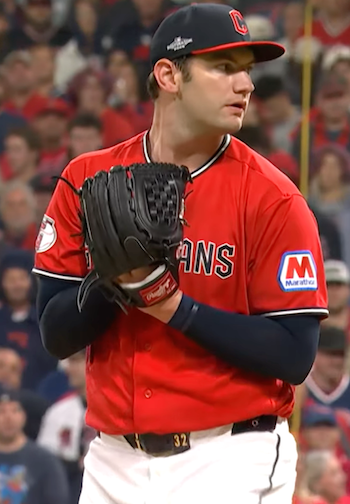
Gavin Williams (with 12) tied Charles Nagy’s Cleveland franchise single-game postseason strikeout record.

Unfortunately, there are some things even a pope can’t bring about. Whatever the Holy See’s divine pull, even he couldn’t deliver the White Sox from the hands of their adversaries. The hands or, in the case of the Guardians, the arms.

By the way, that’s the American League Central-winning Guardians. That means that this year’s American and National League Championship Series will be played strictly by teams who finished the regular season in first place.

So take that, Commissioner Pepperwinkle and your claque, you suggesting the shorter regular season, further diluted (sorry, expanded) postseason with best-of-seven division series, and letting the higher-seeded teams choose their victims (sorry, opponents) in the wild card and division series rounds.

Take that, baseball government spokesman Glen Caplin, and while you’re at it, take your formal statement and shove it:

A shorter regular season unlocks making October even better for our fans—with fewer weekday afternoon games, a longer Division Series, and more opportunities to see the game’s best pitchers on the biggest stage. And allowing the top seeds to select their opponents in the first two rounds would create compelling storylines, intensify existing rivalries, and create new ones.

The pre-LCS is long enough as it is now. We’ve just been through 25 games and, if each set had gone the distance, we could have been through 32. That’s before adding a minimum of eight and maximum of fourteen to come, which would have us at 46 games all postseason long. And what did it all mean this time around?

So far, it’s meant that the cream rose, for the most part. Three out of the four League Championship Series combatants finished one through three overall on the season: the NL Central-winning Brewers (103-59), the NL West-winning Damndodgers (100-62, and yes people do make it sound one word when they say it), and the AL East-winning Rays (98-64).

The Guardians won the AL Central as baseball’s eleventh-best team. Five out of the six teams standing between them and the now-gone NL East champion Braves (94-68) made it into the postseason but got dispatched early enough and, in one or two cases, in utter embarrassment enough.

What was the fun of the Yankees shoving the Red Sox to one side and out of the action in two straight in their wild card series just to turn up even more futile getting swept away by the Rays? What was the fun of the Padres shoving the Cubs to one side and out of the action in two straight only to get bumped off by the Brewers in four?

Chicago had enough heartache when the Cubs got pushed away. Now they have to handle the White Sox, who had an even more charming tale of resurrection following three straight 100+ loss seasons, getting overthrown after it looked early enough and often enough as though they just might overmatch the Guardians.

Savour it, Guards fans. Your heroes are going to their second ALCS in three seasons. Two years ago, the Yankees shoved them away in five. They won’t have things simple against the Rays this time around. But they’re liable to make it fun regardless.

Not that it was simple getting here. The Guards got wrestled down 2-0 to start this division series, and in their own house. Then the set moved to Rate Field, the house where the White Sox delivered a storybook resurrection this season, then flattened what was left of injured and aging Houston in the wild card round.

You thought the White Sox got a bit rude in the Guards’s house? The Guards shifted from scoring a mere three across division series Games One and Two to scoring four in the top of the Game Three third alone. They shifted from resembling the team over which the White Sox might step into overthrowing them twice in Rate Field and once in their own joint.

This time, it wasn’t a higher-scoring huff. This time, the only scoring the Guards needed was José Ramírez, in the bottom of the fourth and with Steven Kwan aboard on a leadoff single, hitting one over the right field fence. Their pitching—which struck a record 21 White Sox out—took care of the rest. (What a way to bookend their season: as my friend Jessica Brand pointed out, the White Sox opened 2026 by getting punched out 20 times in a game by the Brewers’s pitching staff.)

Sean Burke, José Ramírez

José Ramírez about to hit Sean Burke for the two-run homer that was all the Guards needed on a record-making night for their pitching staff.

Everybody wondered if Guardians starter Gavin Williams would be running on empty, or at least down to his final drops, after his Game Four-ending shutout relief inning. We should all have such depleted tanks. He took a no-hitter into the sixth, including twelve strikeouts (tying Charles Nagy for a Cleveland franchise postseason game record) and striking out the side twice, before he threw a breaking ball errant enough to hit White Sox shortstop Colson Montgomery on the foot to open.

Chicago would love to have many innings back over the city’s postseason history. The sixth Saturday night would have to rank among the top five at least. From the Montgomery plunk, the White Sox went to a two-out base hit from Kyle Teel before Williams’s evening finally ended with a bases-loading walk to Miguel Vargas—with lefthand-hitting first baseman Munetaka Murekami due up and Guards manager Stephen Vogt bringing lefthander Erik Sabrowski in to pitch.

Maybe Murakami would overcome his weakness against portside pitching this time, when the White Sox’s season depended the most upon it? Not quite. Sabrowski struck him out swinging. The best threat of the White Sox’s night evaporated just like that. The Pope watching from his Vatican roost must have been reminded that even he has only so much divine influence.

The Guards needed nothing more than further bullpen bulls Hunter Gaddis and (coming in with one out and a man on first in the eighth) Cade Smith to keep the White Sox pinned. Smith even paid tribute to Williams’s effort by striking the side out in the bottom of the ninth to finish it.

In one way, the outcome didn’t matter: Except for the Damndodgers, the LCSes will be fought by the lower budget corps. The Damndodgers lost their season series to the Brewers, 3-4. The Guardians, with the number 29 player payroll of 2026, fought the number 26 White Sox to get to the ALCS. Where they’ll meet the number 27 payroll Rays.

Never mind that saying the Damndodgers do it with dollars alone is a willfully ignorant lie.

There’s no earthly reason to believe the Brewers will be NLCS pushovers. Not with Jacob Misiorowski starting Game One. And no, Les Mis does not live by fastball alone, even if his is faster and better controlled than Nolan Ryan’s. He’s got a cutter, a slider, and a curve ball, any and all of which can dance like Fred and Ginger and beat, sweep, and clean you like a Hoover.

There’s no earthly reason to believe the Dodgers are invincible despite winning the two previous World Series. (Remember how the Blue Jays got thatclose to winning last year but for old man Miguel Rojas? Commissioner Pepperwinkle hopes you forgot.) Not even with Tarik Skubal starting Game One. Maybe Sku and Les Mis fight to a draw and turn things over to the bulls. Maybe the Brewers start praying their bulls aren’t full of bull. Maybe.

There’s also no earthly reason to believe the ALCS will be a crashing bore. If the Guards keep pitching the way they manhandled the White Sox, assuming their arms and/or shoulders don’t resign their commissions, they stand a chance against a Rays team that figured out how to build a dominant, all-elements team from the Family Dollar clearance shelves.

So the Empire Emeritus and the Olde Towne Team aren’t there? Except for entitlement-drunk Yankee fans who still think the World Series is illegitimate without them (and who still think, erroneously, that only the ghost of George Steinbrenner can “restore” them), who cares? Except for entitlement-longing Red Sox fans who think they’ve earned the right to a fifth Series title this century (they already lead the century with four), who cares?

The Lords of Baseball will cast their longing eyes upon the proceedings, misread the forest, misinterpret the trees, and ignore those among their ranks who lack the up-and-down development, discipline, and intelligence of those now playing for pennants.

Must I remind you that big payrolls (read: $200 million or higher) did the Mets and the Blue Jays no seasonal favours? That they didn’t keep the Yankees, the Phillies, the Red Sox, the Padres, the Cubs, the Braves, and the Astros from early postseason exits?

The Lords, and the fans and writers who think only money determines who takes the next lease to the Promised Land, insist that what you’re seeing coming out of Tampa Bay, Milwaukee, and Cleveland is three flukes, two of whom stand to be used as toothpicks by the big blue whale out of Los Angeles.

Meanwhile, if the Dodgers do get thwarted, the wailing will start swiftly enough over how difficult-to-impossible it is to win more than two straight World Series anymore.

Too many people can never be satisfied. Those who can be will now enjoy a pair of likely to be splendid LCSes and a just-as-likely to be splendid World Series.

The Papal bullpen, and other division series observations

Muneteka Murakami

Munetaka Murakami about to demolish Parker Messick’s pitch for an ALDS Game One home run Saturday. (MLB TV capture.)

Just think. A few more days, and there just might be a pair of League Championship Series lined up with nobody involved except four division winners. Among the division series contenders who didn’t win their divisions, let’s be honest. The most likeable of the group is the White Sox.

Come to think of it, the White Sox did edge the American League Central champion Guardians by one game in their regular season series. Considering where they’d come from only too recently, beating the Guards 3-0 in their division series Game One must have been a confidence builder for which you couldn’t forge a special order.

Back to them in a few.

The National League Central-winning Brewers are a lot closer to that all-champ NLCS after slipping past the wild card Padres from the NL West in division series Game Two Sunday. From a whacky-finish 3-2 Game One win, the Brewers overcame an early fielding mishap and a two-run deficit to win it, 4-3, on a walkoff single.

Game One’s whacky finish involved a ninth-inning American Family Field ricochet roof catch that prevented San Diego’s Ty (Viva la) France from hitting a two-run homer that would have yanked the Padres up and ahead off a one-run deficit. The ball bumped a roof rail and sank into Brewers left fielder Jackson Chourio’s glove.

The ground rules in the park say balls hitting the roof or its cabling in fair territory are in play and catchable for outs as long as the ball stays fair. That’s what an appeal told the Padres, who tried arguing to no avail that the ball was foul.

Maybe the last thing the Friars needed was Chourio in the middle of their Game Two loss. Especially with their best relief pitcher, Mason Miller, out to work the bottom of the ninth on assignment to make their 3-2 lead hold up. Miller didn’t exactly make things simple for himself, either. After a leadoff groundout, he walked Christian Yelich (who stole second as soon as he knew it to be available, practially) and Sal Frelick. He got pinch hitter Andrew Vaughn to fly out to right, but then he walked pinch hitter Gary Sanchez and the pillows loaded.

Enter Chourio, who’d helped make the Padres’s lives miserable enough in Game One. Before he caught the Ricochet Heard ‘Round the World (social media argued about the play almost an entire day to follow), he’d tied Game One in the third with a hefty two-run homer, his fifth bomb of this postseason thus far.

He wrestled Miller to 2-2. Then, he shot a low liner beneath diving Padres second baseman Jake Cronenworth, sending Yelich and Frelick on a frolic home with the tying and winning runs, Frelick coming in a dive Olympic swimmers might have envied.

You might start getting the idea that the Padres may believe their survival chances now depend on having Chourio kidnapped and hidden away on some remote island in sub-Antarctica. Clearly, the guy has no respect for the team that won twenty out of its final 23 regular-season games. To him, and to his fellow Crew members, the Padres are the guys one loss from wait till next year.

Now, back to the White Sox. Well, let’s look big picture first. Didn’t the Braves look unintimidated for having lost their NL division series Game One by two to the Damn Dodgers, with Tarik Skubal manhandling them and Teoscár Hernández, Kyle Tucker, and Max Muncy taking them over the Dodger Stadium fences? Of course not.

Don’t the Rays feel a little more than confident leading their AL division series 1-0, after Drew Rasmussen got close enough to no-hitting the Yankees—before Austin Wells got a little greedy after busting the no-no in the eighth, and thrown out trying to make his double a triple? And, after Jonathan Aranda provided the game’s only run when he went against the usual Rays way (ninth from the bottom of the Show for long balls) and hit one into the right field seats in the third?

Of course they do. And don’t think Pope Leo XIV’s favourite team doesn’t feel all varieties of confident entering their AL division series against the Guards.

They dispatched the Astros in the wild card series so swiftly it was legitimate to question whether that set was just a magic trick. Then, they bullpenned the Guards quiet in ALDS Game One. (The papal bullpen?)

Meanwhile, Munetaka Murakami’s hefty two-run homer in the fourth, Colson Montgomery’s RBI double in the seventh, and the White Sox bulls striking out twelve among them, while leaving the Guards stranding the bases loaded twice, took care of the rest.

But I sense a lot of people not tied to Chicago pulling for at least one non-division champ to make it to the LCS. That would be the gang who broke the Original Mets’s single-season loss record two years ago, picked themselves up, dusted themselves off, tinkered here, tucked there, then shoved the Astros to one side.

God bless the White Sox. The Pope already did.

In fact, that blessing plus the swift wild card series dispatch inspired a sentence that ought to win this year’s Pulitzer Prize—if there is a Pulitzer for single lines. “An offense predicated on power and prayer got none of the former and played a team with the Pope on its side,” wrote The Athletic‘s Chandler Rome. (It had to be a writer named Rome?)

Suddenly it’s to wonder and possibly fear the Padres picking up, dusting off, pushing the Brewers to a fifth game overthrow, and finding ways to win the NLCS from there. Think of the mad fun Rome (the writer, not the Vatican) and others may have if the White Sox finish the Guards off, then prevail in an ALCS.

A World Series featuring Friars on one side and a team with the Pope as a lifelong fan on the other side. And you thought a hypothetical Cubs vs. Red Sox World Series might test the Lord’s patience.

Retirement, Verlander style

Genevieve Verlander, Justin Verlander

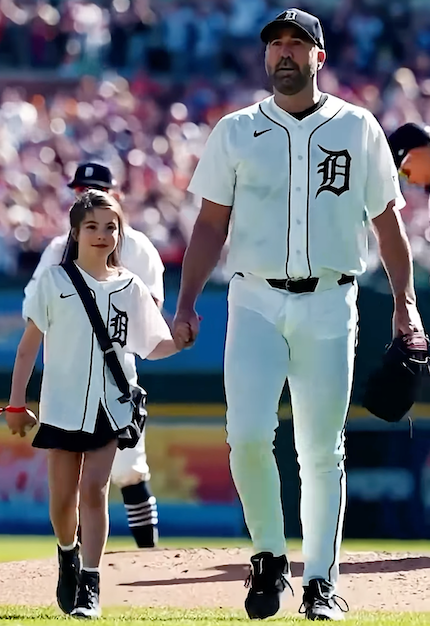
Daughter escorts father from the mound without a dry eye in the Comerica Park house Saturday.

The games meant nothing and everything at once. Nothing in the big picture of the Tigers’s season or the postseason they’re going to miss, but everything to their retiring Hall of Famer in waiting and his family. Especially his seven-year-old daughter.

Genevieve Verlander—that’s Vivi to her family and friends, as seen on the Tigers jacket she wears—highlighted the Tigers’s commemoration of Justin Verlander Friday night with a ceremonial first pitch curve not necessarily unlike the ones her father threw in his heyday.

Daddy himself squatted down to take the pitch. The split second it hit his glove, Verlander thrust his arms skyward and galloped out to sweep her up as she leaped into the arms she’s going to feel far more now than in her first years.

“It’s been awesome,” Verlander told MLB.com’s Jason Beck about their preparations. “We’ve been practicing. She’s all pumped up about it. We actually came out here to the field and practiced off the mound one day. I asked her, ‘Where do you want to go? You want to go to the mound?’ And she’s like, ‘The mound.’ I’m like, ‘That’s my girl’.”

The lack of dry eyes in the Comerica Park house could be equaled by one thing only, and it happened on the following afternoon. At the end of a season Verlander lost to injury in April, willing his way back to make a final stand before beginning the retirement he announced in July.

That’s when Verlander took the mound for the final time in his major league life, against the Pirates. When he pitched almost like a reasonable facsimile of his classic self, surrendering a measly two runs, both on solo home runs, then got the first out of the sixth and a surprise unlike any his career had brought him before.

This time, Vivi had more help. From mother Kate Upton and Tigers manager A.J. Hinch, who’d once also managed her father in Houston. They’d plotted this very moment. Verlander had no clue what would happen after he lured Brandon Lowe into a pop out to catcher Dillon Dingler.

Hinch walked out to plate umpire Laz Diaz to inform him of the pitching change. Then he motioned to the first base side. Vivi ran out toward the mound wearing an even bigger grin than the one behind which she threw the Friday night curve. Father and daughter hugged even harder this time around.

And Verlander—one of the most composed pitchers who ever stood on the mound before tying lineups into knots; a competitor who married power to smarts and feel to analytics; a lion so intense that it took marriage and fatherhood to let him look more human than he looked in his bristling younger seasons; a lancer who’d spent his final innings on the mound ironed up for work as always—lost it.

He wept. Unashamedly, unapologetically. Even Hinch looked as though he might shed a few tears as he joined father and daughter for a quick mini-group hug. “It hit me like a ton of bricks,” Verlander admitted after the game. He also admitted he hoped Vivi would understand he wept for joy, not sorrow.

This beat any father-daughter dance on record so far.

“He’s a really hard guy to surprise,” acknowledged Finch, who attests to numerous conversations with Verlander about fatherhood and family life. “He’s as planned out and mapped out as any human I’ve ever been around. And so I contacted Kate a little while ago and just tried to think about ways that we could create a special moment for him.”

It must have hit the Tigers like a ton of bricks that Verlander walked off the mound with Vivi in his arm and into the arms of her mother and her younger brother, Bellamy, with the Tigers in a 2-0 hole. (Lucky Pirate boys Lowe and Jacob Gonzalez. They get to brag that they took a Hall of Famer yard on his final day in the bigs.)

Lucky for them they could wrestle back to where a 3-1 deficit in the bottom of the ninth was, for once, just a simple hurdle.

First, Kevin McGonigle pushed Max Clark (one-out single) across the plate and Hao-Yu Lee (double) to third. Then Eduardo Valencia won it with a clean blast into the left field seats. Verlander wouldn’t get credit for a pitching win, but nobody questioned he and his family had won the day. And the weekend.

Detroit probably won’t remember Saturday’s final score as heavily as they’ll remember Vivi racing out to make sure her father wouldn’t step off the mound alone. In baseball terms, they’ll have far older memories to hold, as The Athletic‘s Cody Stavenhagen noted:

Electric strikeouts in the playoffs. Thrilling feats of dominance on so many summer days. He is best known throughout the sport for his longevity and his durability, a near-unbreakable force who lived to see an era where starters are coddled rather than pushed, where battles are won through algorithms and optimization just as much as they are heart and grit. The way he embraced it all, the old and the new, is part of what helped him outlast so many of his peers.

The family embraced again in front of the dugout and in front of Verlander’s teammates, with whom he’d share some final handshakes. Comerica Park rocked in tribute to the big righthander. He’d pitched for his heart and soul Saturday, and they knew it.

“It felt very storybook,” Upton said after the game. “And it was so Justin. That’s the most Justin Verlander thing I’ve ever seen.” She could have been referencing his pitching and his paternal vulnerability at once.

Then, the family disappeared through the dugout to the clubhouse and toward the rest of their lives.  Suddenly, you forgot the grizzled veteran resembling a prospector in the mountains too long, saying goodbye to the game he enhanced, stepping full time into the family life that didn’t unmake the three-time Cy Young Award-winning, 3,560-strikeout pitcher, but remade the man.

“I never wanted to retire because of a milestone, a number or a date on the calendar. I wanted the game to tell me it was time,” wrote the 43-year-old in a social media post.

Baseball has given me more than I could have imagined. It taught me discipline, resilience and the value of continuing to adapt and evolve. I’ve been fortunate to play with and against incredible players, for outstanding organizations and compete in front of fans who deeply appreciate the game.

Don’t waste your time pondering that Saturday’s quality start might portend Verlander rethinking retirement. He knows his body would laugh and bark, “That’s what you think.”

One day, perhaps Vivi Verlander will come to understand that she did a lot more than just charm the living daylights out of Detroit and baseball nation with her Friday night pitch and Saturday afternoon escort. God and her parents willing, she’ll see she helped her father do what too many of the greats fail to do. Hell, she helped him do what too much of this regular season failed to do.

She helped him leave baseball fans wanting more. But the only thing more her father can give fans from here is a speech on the Cooperstown stage in five years.